
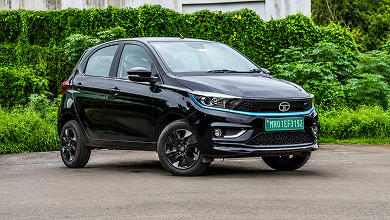
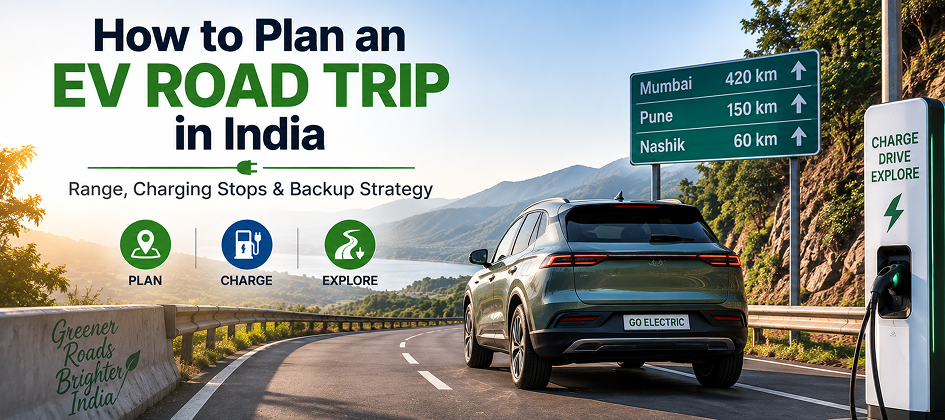
Electric vehicles (EVs) are no longer confined to city commutes. With expanding highway networks, fast-charging corridors, and longer-range electric cars, taking an EV on a long-distance road trip across India is more achievable than ever.
However, long-distance driving in an electric car requires a shift in mindset compared to traditional petrol or diesel vehicles. You cannot simply drive until the fuel low-light turns on and expect a petrol pump at every kilometre. Successful EV road trips require understanding realistic vehicle range, mapping out reliable charging stops, and preparing contingency plans.
Whether you are planning your first interstate highway drive or evaluating an EV purchase for family road trips, this guide breaks down how to plan an EV road trip in India smoothly, safely, and efficiently.
Driving an electric vehicle long distance introduces key differences compared to internal combustion engine (ICE) vehicles:
Refuelling vs. Charging: Gasoline pumps deliver hundreds of kilometres of range in under five minutes. EV fast charging typically takes 30 to 60 minutes depending on battery size, charger output, and the vehicle’s charging curve.
Highway vs. City Efficiency: Unlike petrol or diesel cars, which often achieve better fuel economy on open highways, EVs generally consume more energy at high highway speeds due to aerodynamic drag and sustained power draw without frequent regenerative braking.
Planning vs. Spontaneity: While petrol pumps are ubiquitous across Indian national highways, high-power DC fast chargers require strategic planning.
Destination Charging: Charging while parked overnight at hotels, homestays, or resorts can offset the need for daytime fast-charging stops.
When evaluating your vehicle's capability, distinguish between official test numbers and real-world performance:
Certified/Claimed Range: The range achieved under standardised laboratory testing conditions (such as ARAI or MIDC in India).
Real-World Range: The actual distance an EV covers under typical mixed driving conditions.
Highway Range: The specific distance covered when cruising continuously at highway speeds (e.g., 80–100 km/h).
Usable Battery Capacity: The actual energy capacity (in kWh) accessible for driving, which is slightly less than the total gross battery capacity.
High Speeds: Cruising above 80–90 km/h significantly increases aerodynamic drag, leading to higher kWh consumption per kilometre.
Air Conditioning: Continuous cabin cooling under intense Indian summer conditions draws power directly from the main battery.
Vehicle Load: Carrying a full load of passengers and heavy luggage increases rolling resistance.
Terrain and Elevation: Driving uphill into mountain regions (e.g., the Western Ghats or Himalayas) consumes significantly more energy than driving on flat terrain.
Tyre Pressure: Under-inflated tyres increase rolling resistance and reduce efficiency.
Headwinds & Adverse Weather: Strong headwinds or heavy rain require extra power to maintain speed.
Illustrative Example Only: If an electric car has a certified range of 450 km, its real-world mixed range might be around 320–350 km. When cruising on a national highway at 90 km/h with full AC, the practical range may further adjust to roughly 260–280 km.
Never plan to deplete your battery down to 0% before reaching a charger. Always factor in a practical safety buffer.
Usable Highway Range - Safety Buffer = Practical Trip Distance Between Stops
Why maintain a safety buffer (such as 15% to 20% remaining battery)?
The primary charger at your planned stop might be occupied, out of service, or blocked.
Traffic jams or highway detours can increase total energy draw.
Sudden weather changes or heavy rain can lower efficiency.
Arriving with a reserve allows you to comfortably reach an alternative charger nearby.
Before embarking on your journey, map out the entire route rather than focusing solely on the first leg:
Identify Highway Corridors: Stick to major national highways (NH) where fast-charging density is higher.
Mark Key Rest Stops: Coordinate charging stops with meal breaks, rest areas, or food plazas to maximise time efficiency.
Review Elevation Profiles: Note major climbs or hilly stretches that will increase battery drain.
Locate Alternative Paths: Identify secondary routes or nearby towns that offer backup charging infrastructure.
When researching charging locations using charger aggregator apps or network platforms (such as Tata Power EZ Charge, Statiq, Jio-bp Pulse, PlugShare, or Zeon Charging), verify the following parameters for each stop:
Distance From Previous Point: Ensure the gap is well within your practical travel range.
Charger Type & Connector: Verify that the station offers CCS2 connectors for DC fast charging (the standard for most electric cars in India).
Charger Output Rating: Check whether the charger is 24 kW, 30 kW, 50 kW, 60 kW, or 120+ kW. Higher-power chargers reduce dwell time if your EV supports higher input rates.
Operational Status: Read recent user reviews or check real-time app status to confirm the charger is online and functional.
Payment Methods: Pre-download the respective charging network apps and add funds to digital wallets if required.
Amenities: Confirm the presence of clean restrooms, food outlets, and well-lit parking, especially when travelling with family or at night.
| Charging Type | Speed Range | Ideal Use Case on Road Trips | Considerations |
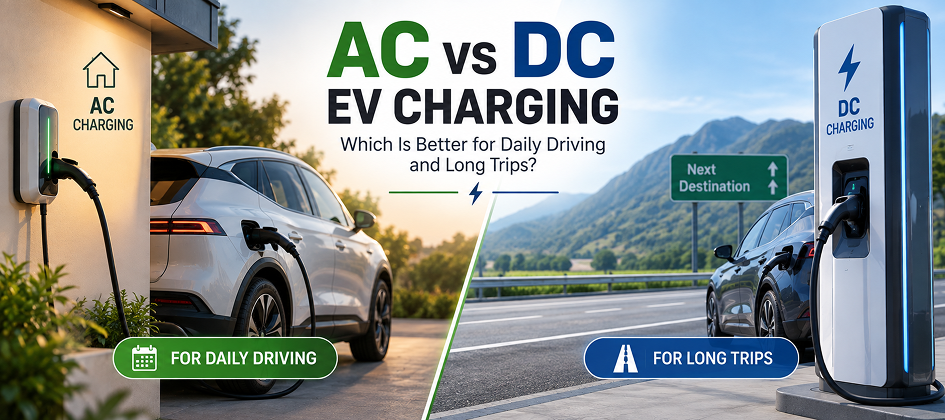
| AC Charging (3.3 kW – 22 kW) | Slower (Hours) | Overnight stops, destination charging at hotels, or extended meal stops. | Requires bringing your portable cable or Type 2 connector cable. |
| DC Fast Charging (24 kW – 120+ kW) | Fast (Minutes) | En route, highway stops during short breaks. | Charging speed slows down automatically above 80% state-of-charge (SoC) to protect battery health. |
DC fast charging is fastest between 10% and 80% state-of-charge. Above 80%, the vehicle's battery management system (BMS) tapers down the charging speed significantly to safeguard battery cells. On a highway trip, it is usually more time-efficient to unplug at 80% and resume driving rather than waiting to reach 100%, provided your next stop is within range.
The table below illustrates how a structured itinerary might look for a multi-stop highway trip:
| Stop. | Approx. Distance | Charger Type | Target Battery Status | Primary Purpose | Contingency Plan |
| Start | 0 km | Home AC Charger | 100% | Departure | N/A |
| Stop 1 | 180 km | 50 kW DC Fast | Arrive ~25%, charge to ~80% | Breakfast break & main top-up | Secondary DC charger 12 km ahead |
| Stop 2 | 350 km | 60 kW DC Fast | Arrive ~20%, charge to ~75% | Lunch break & quick charge | Alternative station at highway food court |
| Destination | 500 km | Hotel AC / Public DC | Arrive ~25% | Overnight destination charge | Nearby public fast charger |
(Note: The distances, battery percentages, and charger types above are strictly illustrative. Always plan according to your specific vehicle specifications and actual route infrastructure.)
Never rely on a single charger without a backup strategy. Adopt the A-B-C Strategy:
PLAN A (Primary Charger): Your intended stop at a highway rest area or food court.
PLAN B (Secondary Charger): An alternative charging station located 15–30 km before or after Plan A.
PLAN C (Emergency Option): A slower AC charger, a hotel socket, or roadside assistance in case of unexpected closures or power outages.
Check Station Queue: If occupied, evaluate whether waiting 15–20 minutes is faster than driving to your Plan B stop.
Contact Customer Support: Use the helpline number printed on the charging station to check if a remote reset can resolve an offline charger issue.
Switch Networks: Open aggregator platforms to locate nearby charging points managed by alternative operators.
Destination charging refers to topping up your battery while parked at your final destination (hotel, resort, or homestay).
Hotel Infrastructure: Contact the property prior to booking to confirm if they have a dedicated EV charger or allow access to a grounded 15A socket.
15A Socket Access: If using a standard 15A plug, ensure the extension cable is heavy-duty, outdoor-rated, and properly earthed.
Nearby Public Infrastructure: If the accommodation lacks charging access, identify public DC or AC chargers in the vicinity where you can charge before checking in.
Highway EV driving costs depend on electricity source, operator tariffs, and charging speeds.
Total Cost (INR) = Total kWh Consumed x Tariff Rate per kWh
Home Charging: Billed at standard residential slab rates (typically INR 6.00 – INR 10.00 per kWh, depending on state regulations).
Public AC Charging: Commonly priced between INR 12.00 and INR 18.00 per kWh (+ GST).
Public DC Fast Charging: Commonly priced between INR 18.00 and INR 25.00+ per kWh (+ GST), depending on operator, location, and charger capacity.
Illustrative Cost Calculation:
Total Trip Distance: 500 km
Real-World Efficiency: 7.0 km per kWh
Total Energy Needed: $500 \div 7.0 \approx 71.4 kWh
Assuming 15 kWh filled at home (INR 8/kWh) = INR 120
Remaining 56.4 kWh at Public DC Fast Chargers (Average INR 22/kWh + GST $\approx$ INR 26/kWh) = INR 1,466
Estimated Energy Cost: Approximately INR 1,586 for 500 km.
The number of charging stops depends on your vehicle's real-world highway range, battery size, driving speed, total distance, and safety buffer.
For an electric car with a real-world highway range of 250 km per full charge:
Departure: Start at 100% SoC.
First Leg (~180 km): Stop at ~28% SoC. Fast charge back to 80% (adds ~130 km range).
Second Leg (~160 km): Stop at ~25% SoC. Fast charge back to 70–80% (adds ~120 km range).
Final Leg (~160 km): Arrive at destination with ~20% reserve battery.
Total Highway Stops: 2 fast-charging stops combined with meal/rest breaks.
Implement these driving techniques to maximise highway range:
Maintain Steady Speeds: Cruising smoothly at 80–85 km/h uses considerably less energy than driving at 100–110 km/h.
Utilise Regenerative Braking: Use moderate regen modes in traffic or downhill sections to recapture kinetic energy.
Set Climate Control Efficiently: Maintain AC temperature around 24°C–25°C in auto mode rather than minimum cooling settings.
Check Tyre Pressures: Ensure tyres are inflated to manufacturer-recommended cold pressure specs before starting.
Travel Light: Avoid roof racks or unnecessary heavy cargo that adds aerodynamic drag and weight.
Use Eco Driving Modes: Engage your EV’s Eco mode to smooth out throttle response and optimise power delivery.
If unexpected headwinds, rain, or heavy traffic cause your state-of-charge to drop rapidly:
Remain Calm: Modern EVs provide clear battery warnings well before depletion.
Reduce Cruising Speed: Dropping speed from 90 km/h to 70 km/h immediately reduces power consumption.
Adjust Climate Control: Switch AC to eco mode or turn off high-power cooling temporarily.
Locate the Nearest Charger: Use charging apps to navigate to the closest verified charger immediately rather than pushing to your original target stop.
Contact Roadside Assistance (RSA): If battery levels become critically low, pull over safely and contact your vehicle manufacturer's or insurer's RSA service for flatbed towing.
High Heat Impact: Ambient temperatures above 40°C increase battery cooling demands and AC load.
Planning Tip: Park in shaded areas while fast charging to prevent thermal throttling of charging speeds.
Water & Resistance: Heavy rain and standing water increase rolling resistance, reducing overall range.
Planning Tip: Allow extra safety buffers, as highway traffic slows down and driving energy consumption increases.
Uphill vs. Downhill: Climbing steep inclines significantly increases consumption. Conversely, descending hills recharge the battery via regenerative braking.
Planning Tip: Calculate range conservatively for the uphill leg; expect minimal net consumption on steep descents.
Aerodynamic Drag: Smooth motorways invite higher cruising speeds, which deplete battery reserves faster.
Planning Tip: Set cruise control to moderate speeds (80–90 km/h) to maintain predictable efficiency.
Before heading out on an interstate EV journey, verify this checklist:
[ ] Vehicle Check: Inspect tyre pressure (including spare tyre, if equipped) and fluid levels.
[ ] Full Charge: Charge the battery to 100% at home prior to departure.
[ ] Route Mapping: Pre-plan primary (Plan A) and backup (Plan B) charging stations.
[ ] App Preparation: Download required charging network apps and ensure payment wallets are funded.
[ ] Portable Cable: Pack the factory-supplied 15A trickle charger and Type 2 cable in the boot.
[ ] Destination Check: Confirm hotel/resort charging availability in advance.
[ ] Emergency Contacts: Store numbers for Roadside Assistance (RSA) and charging network helplines on your phone.
[ ] Power Bank & Phone: Keep mobile devices charged for navigation and app access.
Map out your route using verified charging aggregator tools.
Identify backup charging stops every 150–200 km.
Confirm destination charging with your hotel or stay.
Cruise at steady, efficient highway speeds (80–90 km/h).
Charge during natural rest and meal stops.
Unplug at 80% during fast-charging stops to save time.
Plug into AC charging overnight so your vehicle is ready for local sightseeing or the return leg.


Manage reminders, payment status, and renewal dates from one simple app.


Trusted by policyholders to track every renewal.

